


At a Glance
- English-to-Arabic translation quality can be evaluated using metrics such as BLEU and COMET, where differences of 3–5 points are considered significant.
- General-purpose tools like Google Translate are designed for everyday use, while specialized solutions focus on business scenarios requiring higher accuracy and terminology consistency.
- Enterprise translation solutions often support both cloud APIs and on-premise deployment, enabling organizations to meet data security and compliance requirements.
- Businesses use English-to-Arabic translation to process documents, automate workflows, and provide multilingual customer support.
- Custom glossaries and domain adaptation are important for ensuring accurate translation of industry-specific terminology (finance, telecom, government).

Disclaimer: This article was prepared by Lingvanex experts in machine translation, including machine learning engineers, computational linguists, and evaluation specialists. The analysis is based on internal testing using industry-standard metrics such as BLEU and COMET. The evaluation is based on ongoing internal benchmarking and model improvements.
In today’s global economy, accurate English-to-Arabic translation is essential for businesses operating in the Middle East and other Arabic-speaking markets. Whether it’s customer communication, documentation, or digital content, translation quality directly impacts trust, compliance, and user experience.
Lingvanex has developed an advanced English-to-Arabic machine translation model and Arabic translation API designed specifically for enterprise use. Built to handle the linguistic complexity of Arabic and the demands of real-world business scenarios, it delivers high translation accuracy, contextual understanding, and flexible deployment options, including secure on-premise solutions.
By focusing on the needs of B2B companies, Lingvanex helps organizations improve communication with Arabic-speaking audiences, streamline multilingual workflows, and confidently expand into new markets.
Introducing the Next Level of Translation Excellence
Lingvanex goes beyond basic machine translation by delivering accurate, context-aware English-to-Arabic translation for real-world business scenarios. This Arabic machine translation solution is designed to handle the linguistic complexity of the language in enterprise environments.
Trained on a large-scale, diverse dataset, the model delivers high translation accuracy across multiple industries, including business, technology, education, and government. This makes it suitable for tasks such as document translation, content localization, and multilingual communication.
With support for both cloud-based APIs and on-premise deployment, Lingvanex provides a flexible Arabic translation API tailored to enterprise requirements.
Why Businesses Choose Lingvanex for English-to-Arabic Translation
Lingvanex provides enterprise-grade English-to-Arabic translation software designed for accuracy, security, and scalability. Whether you're translating sensitive documents, localizing digital content, or supporting multilingual communication, our solution is built to meet real business requirements. Key Benefits:
Translation Quality
Our model delivers industry-leading English-to-Arabic translation accuracy, validated by metrics such as BLEU and COMET. Continuous training and updates ensure consistent performance across business, technical, and domain-specific content.
High-Speed Performance
For organizations that require speed and data control, Lingvanex offers on-premise translation solutions that integrate directly into your infrastructure. This ensures low latency, maximum performance, and full compliance with data security requirements.
Glossary and Industry Adaptation
Lingvanex allows businesses to create custom glossaries and adapt translation models to specific industries, including finance, healthcare, telecommunications, and government. This ensures terminology consistency and improves translation quality for specialized content.
LLM Integration for Post-Editing
Our system leverages Large Language Models (LLMs) for post-editing, improving context understanding and ensuring that translations preserve meaning, tone, and intent, especially important for customer-facing and business-critical content.
Flexible Integration Options
Our solutions are available in two formats:
- Cloud API – Instant access to our service with no complex setup.
- On-premise – Perfect for businesses requiring data privacy and operations within their own infrastructure.
How Businesses Use Lingvanex for Arabic Translation
Companies across industries use Lingvanex English-to-Arabic translation software to automate workflows, improve communication, and scale operations in Arabic-speaking markets, including the Middle East and GCC countries.
Leading organizations such as ITWorks, Newscatcher, Khorafi Business Machines, Topic Portal, and Tarjama use Lingvanex to solve real business challenges related to multilingual content and communication.
Key Use Cases
- News and Media Localization. Media platforms use Lingvanex to translate news content from multiple languages into Arabic for fast and localized distribution across Middle Eastern audiences.
- Document Translation and Workflow Automation. Businesses automate the translation of documents, customer inquiries, and internal communications, including Arabic-to-English and English-to-Arabic processing to streamline document workflows and reduce manual effort.
- System Integration and Data Management. Companies integrate Lingvanex translation APIs into their internal systems to improve data processing, multilingual content management, and cross-language communication.
- Multilingual Document Management. Organizations handling large volumes of multilingual data use Lingvanex to simplify document storage, retrieval, and translation processes across languages.
- Multilingual Customer Support. Platforms and service providers use Lingvanex to enable real-time multilingual communication, improving customer support for Arabic-speaking users and global audiences.
- Arabic PDF and Large File Processing. Lingvanex also provides a PDF translation and conversion tool optimized for Arabic, enabling businesses to process large documents efficiently while maintaining formatting and accuracy.
Why Arabic is One of the Most Challenging Languages for Machine Translation
Arabic is widely considered one of the most complex languages for machine translation due to its rich linguistic structure, regional diversity, and context sensitivity. These challenges make high-quality English-to-Arabic translation particularly difficult without advanced models.
Complex Morphology
Arabic has a highly complex morphological system based on root patterns. A single root can generate dozens of related words depending on context, tense, gender, and grammatical structure.
For example:
- verbs change form depending on subject and tense;
- nouns vary based on definiteness, number, and case;
- prefixes and suffixes are often attached directly to words.
This creates a large number of possible word forms, making accurate translation significantly more difficult compared to languages with simpler structures like English.
Regional Dialects
Arabic is not a single uniform language. While Modern Standard Arabic (MSA) is used in formal communication, there are many regional dialects across the Middle East and North Africa.
Key challenges include:
- differences between Gulf, Levantine, and Egyptian Arabic;
- informal vs formal language usage;
- variations in vocabulary and expressions.
A translation model must be able to handle both standardized and region-specific language to be effective in real-world applications.
Context and Meaning
Arabic is highly context-dependent, meaning that the same word or phrase can have different meanings depending on how it is used.
Challenges include:
- ambiguity in sentence structure;
- reliance on context for correct interpretation;
- idiomatic expressions that do not translate literally.
For business and technical content, preserving meaning and intent is critical – especially in industries like finance, legal, and customer support.
Why This Matters for Businesses
Due to these linguistic complexities, basic translation systems often produce inaccurate or unnatural results when working with Arabic. Advanced machine translation models must go beyond word-for-word translation and fully understand context, grammar, and domain-specific terminology.
This is why high-quality Arabic translation solutions require specialized training, domain adaptation, and advanced post-processing techniques.
How Businesses in the Middle East Use Arabic Translation
Businesses across the Middle East operate in highly multilingual environments, where accurate Arabic translation is critical for compliance, customer experience, and operational efficiency. Lingvanex solutions are widely applicable across key industries in the region:
Banking and Financial Services in the UAE
Financial institutions in the UAE require precise and secure translation of documents such as contracts, compliance reports, and customer communications. Lingvanex enables banks and fintech companies to:
- translate financial documents between English and Arabic with high accuracy;
- ensure consistency of terminology using custom glossaries;
- maintain data privacy through on-premise deployment.
This is particularly important in regulated environments where mistranslations can lead to legal and financial risks.
Government and Public Services in Saudi Arabia
Government organizations in Saudi Arabia must provide services in Arabic while also interacting with international stakeholders. Lingvanex helps public sector entities to:
- localize official documents and digital services;
- translate citizen requests and internal communications;
- support multilingual platforms for residents and businesses.
Accurate translation ensures accessibility, compliance, and efficient public service delivery.
Telecommunications and Customer Support in the Middle East
Telecom providers and digital platforms across the Middle East serve millions of users speaking different languages. Lingvanex enables companies to:
- provide real-time multilingual customer support;
- translate large volumes of user-generated content;
- improve customer experience through consistent Arabic localization.
This is especially valuable for scaling support operations without increasing operational costs.
Enterprise Content and Media Localization Across GCC Countries
Media companies, marketplaces, and SaaS platforms need to rapidly localize content for Arabic-speaking audiences. With Lingvanex, businesses can:
- translate news, product descriptions, and platform content;
- automate multilingual workflows;
- ensure cultural and linguistic accuracy across regions.
Evaluation Methodology
To ensure an objective and reliable comparison between Lingvanex and Google Translate, we conducted an evaluation using industry-standard machine translation metrics and a representative dataset.
Dataset and Domains
The evaluation was performed on a mixed-domain dataset consisting of English–Arabic sentence pairs. The dataset included content relevant to real-world business use cases, such as:
- business and corporate communication;
- news and media content;
- technical and product documentation.
This approach ensures that the results reflect practical translation scenarios encountered by enterprises operating in Arabic-speaking markets.
Evaluation Setup
Both Lingvanex and Google Translate were tested on the same dataset under identical conditions. The outputs were compared against high-quality human reference translations to ensure fairness and consistency.
Metrics Used
We used two widely recognized automatic evaluation metrics:
- BLEU (Bilingual Evaluation Understudy) – measures the overlap between machine-generated translations and reference translations at the n-gram level, reflecting fluency and lexical accuracy.
- COMET (Crosslingual Optimized Metric for Evaluation of Translation) – a neural evaluation metric that assesses semantic similarity, capturing how well the meaning and context of the original text are preserved.
Interpretation of Results
In machine translation, a difference of 3–5 BLEU points is generally considered significant and indicates noticeable improvements in translation quality. COMET scores further validate whether the translation preserves meaning and context, which is especially important for business-critical content.
This evaluation framework allows for a fair and meaningful comparison of translation quality across systems and highlights real performance differences in enterprise-relevant scenarios.
Lingvanex vs. Google Translate for Arabic
When choosing an English-to-Arabic translation solution or Arabic translation API, businesses often compare Lingvanex with widely used tools like Google Translate. While Google offers a general-purpose translation service, Lingvanex is specifically designed for enterprise use cases, where accuracy, data security, and customization are critical.
English-to-Arabic Translation Benchmark: BLEU and COMET Scores Explained
- BLEU (Bilingual Evaluation Understudy) is an automatic metric that evaluates machine translation quality by comparing it to a reference translation. The score ranges from 0 to 100 – the higher the score, the better the translation.
- COMET (Crosslingual Optimized Metric for Evaluation of Translation) is a metric that automatically evaluates machine translations by comparing them to reference translations. Like BLEU, it scores from 0 to 100, with higher scores indicating better translation quality.
Translation Accuracy and Quality
Lingvanex demonstrates higher translation accuracy for English-to-Arabic tasks based on industry-standard evaluation metrics.
- BLEU score: Lingvanex – 51.12 vs Google – 46.94 (Picture 1.).
- COMET score: Lingvanex – 89.68 vs Google – 85.32 (Picture 2.).
A difference of 3–5 BLEU points is generally considered significant in machine translation and reflects noticeable improvements in fluency and phrase accuracy. Higher COMET scores also indicate better preservation of meaning and context, especially important for business, legal, and technical content.
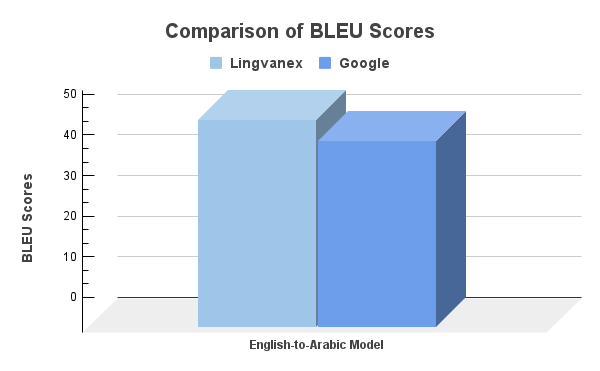
Picture 1. BLEU Score Comparison for English-to-Arabic Translation: Lingvanex vs. Google
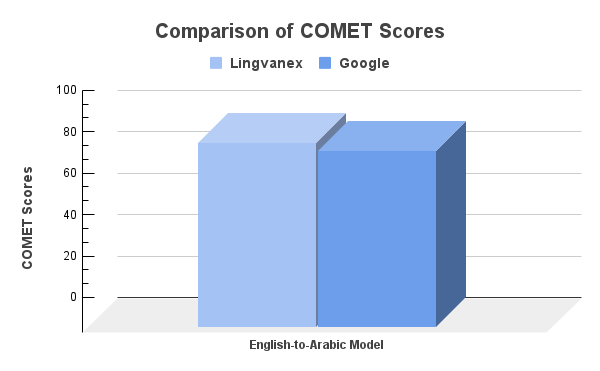
Picture 2. COMET Score Comparison for English-to-Arabic Translation: Lingvanex vs. Google
Context and Domain Adaptation
Google Translate is optimized for general usage across a wide range of topics. In contrast, Lingvanex focuses on business-specific scenarios and allows:
- custom glossaries for industry terminology;
- domain adaptation for finance, healthcare, telecom, and government;
- improved handling of formal and structured content.
This makes Lingvanex more suitable for enterprise environments where consistency and accuracy are essential.
Data Security and Deployment Options
One of the key differences is deployment flexibility:
- Google Translate is primarily a cloud-based service.
- Lingvanex offers both cloud API and on-premise deployment.
On-premise solutions allow organizations to:
- keep sensitive data within their infrastructure;
- meet regulatory and compliance requirements (especially in the Middle East);
- ensure full control over data processing.
Performance and Scalability
Lingvanex provides high-performance translation solutions optimized for enterprise workloads:
- low-latency processing in on-premise environments;
- scalable API integration for large volumes of content;
- reliable performance for real-time and batch translation.
Which Solution to Choose for Your Business
Google Translate remains a convenient tool for everyday use and quick translations. However, for businesses operating in Arabic-speaking markets, especially in regulated industries such as finance, government, and telecommunications – Lingvanex offers a more robust and specialized solution.
With higher translation accuracy, domain customization, and secure deployment options, Lingvanex is better suited for organizations that require reliable, scalable, and context-aware English-to-Arabic translation.
Why This Matters for the Middle East
In regions such as the UAE, Saudi Arabia, and other GCC countries, accurate Arabic translation is critical for compliance, customer communication, and digital services. Errors in translation can lead to misunderstandings, legal risks, and poor user experience.
Lingvanex helps businesses minimize these risks by delivering consistent, high-quality translations tailored to regional and industry-specific requirements.
Arabic-to-English Translation Model for Large-Scale Content
In addition to our English-to-Arabic solution, Lingvanex offers an advanced Arabic-to-English translation model designed for processing large volumes of text with strong contextual understanding.
This model is optimized for full-text translation, making it particularly effective for tasks such as document translation, content localization, and multilingual data processing. It excels at preserving meaning and context across long passages, which is critical for business, media, and analytical workflows.
While the model is primarily optimized for contextual accuracy rather than word-level precision, it delivers reliable performance for large-scale translation scenarios where overall coherence and speed are more important than individual word accuracy.
Start Using Accurate English-to-Arabic Translation Today
High-quality Arabic translation is essential for businesses operating in the Middle East and global markets. Lingvanex provides tools to support multilingual communication and automate translation workflows for businesses working with Arabic content.
Test the accuracy of our English to Arabic translator in real time or integrate it directly into your systems using our Translation API.
If you’re looking for a tailored solution, our team can help you implement on-premise or cloud-based translation aligned with your business requirements.
Explore Lingvanex translation and speech recognition solutions with a free trial and see how accurate, secure, and scalable machine translation can support your growth.